
How Travelling Can Make You a Better Psychologist
by Dr Marianne Trent & Ben
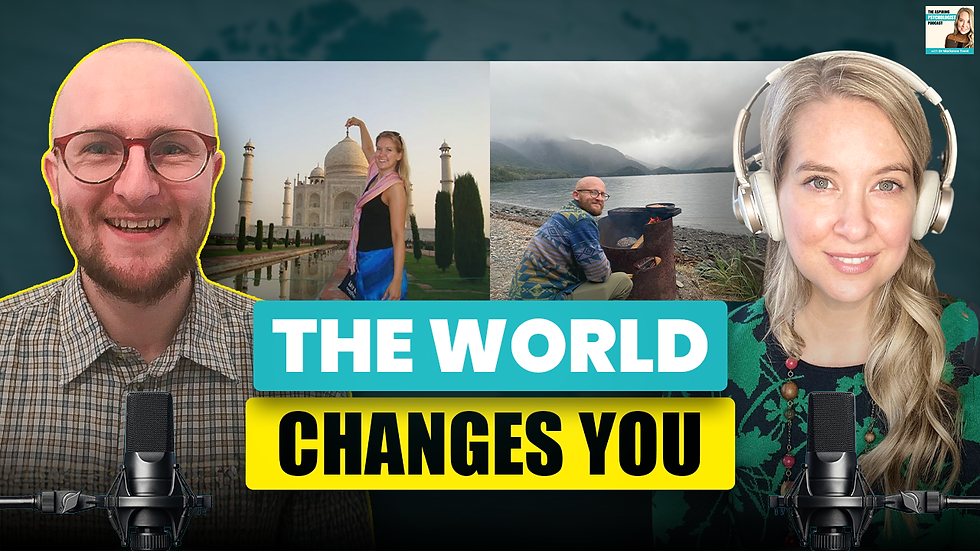
Welcome along to The Aspiring Psychologist Blog. This blog post is an adaptation of the 211th episode of The Aspiring Psychologist. In this episode I talk to Ben about how travelling can make you a better psychologist.
If you would like to listen to this episode, you can find jt here on the Aspiring Psychologists Podcast
You can also watch the episode on my YouTube channel
Marianne:
We don't talk about this enough, but travelling can shape a psychologist just as much as studying or supervision because when you backpack, get lost, meet strangers, experience joy and uncertainty, you build empathy, perspective, flexibility, and the kind of emotional intelligence you often just can't learn in a classroom. So today we are asking what if the time you spend out there in the world is not a detour from psychology, but one of the best trainings you'll ever have
I am Dr. Marianne Trent, a qualified clinical psychologist, and I'm joined here by the very intrepid Ben. Hi Ben, Welcome along.
Ben:
Hi Marianne. Thanks very much for having me. Been very excited to do this ever since you first got in touch.
Marianne:
Well, yeah, thank you for responding to my emails because this is how this came about. Right. So is it okay to say which country you are currently in then?
Ben:
Yeah, absolutely. Yeah, I'm currently in Chile travelling with my partner.
Marianne:
Amazing. And yeah, like I said, you are in intrepid. I think when I spoke to you to plan the episode. Were you in Canada? Have I imagined that?
Ben:
I was, yeah, we've been in Canada for the past year and a quarter ish. We'll talk a little bit more about what I've been up to there, but went back to the UK for a few weeks and then came further south to escape the freezing cold winter.
Marianne:
And the idea of our episode really is to think about how travel can enrich you as an aspiring or qualified psychologist and how it might not be, I guess that narrative of I want to get there as soon as I can get there. I want to be qualified by the time I'm 27 or I want to get there before I'm 30. And actually how we might be able to release the pressure of that and think about what we might learn along the way if we don't go directly to pass, go collect 200 pounds to quote Monopoly, but what we might learn about ourselves, what we might learn about the world, what we might learn about others, and how some of the experiences we have when we're travelling will help us to bolster life when it unfolds later. What are your thoughts around that, Ben?
Ben:
Yeah, absolutely. I feel that pressure as well as does any aspiring psychologist because the goal is to doctorate and then you feel like maybe once you get up to training, that's your path all lined up, even if you're not quite there yet because it can feel a little bit muddy to get there. So people often like myself want to rush through that and I've felt that pressure whilst travelling as well, almost looking far too far into the future and constantly thinking about what I'm going to when I get home and forgetting what am I doing just now because I'm in this beautiful place and I've got all this free time to meet new people and experience new things and reflect on that and just take my time, which is something I'm getting better at the moment.
I'm probably in the most comfortable place I've ever been with not rushing and just taking a moment to absorb what's happening to me just now.
Marianne:
So it really is an exercise in mindfulness, isn't it, of enjoying where you are at right now and maybe appreciating that without then feeling like you need to jump ahead to the next step, the next thing. So it's not holding yourself accountable. Is there anyone holding you accountable? So I know that my mum was very keen for me to come a doctor and if I'd had this protracted period of time, she might be not. But when are you progressing your career or are you literally just living to your own timeline, Ben?
Ben:
Yeah, I don't think I've got any pressure from family or friends or anything like that, which I'm extremely grateful for. And I'm a little bit later in coming to psychology as well. I did an engineering degree out of school and then spent my twenties doing various unrelated jobs. I'm 30 years old now, time of filming and I've not long finished my conversion degree, but my parents have always very much been of the mindset that as long as I'm enjoying what I'm doing and fulfilled, it's irrelevant how I'm doing that, which I feel very grateful for because I don't feel any pressure externally. Maybe I've got that intrinsic pressure, but from the outside I feel very comfortable that I don't need to do anything for the service of anyone else.
Marianne:
Good, good. I'm pleased to hear it. And it might be a whole other episode like thinking about moving from engineering to psychology, but we'll try and stick to travel, but that sounds fascinating as well. And I think when we first met it was because you'd requested a psychology guide and you'd told me what your pressing concern was, and I seem to remember it was along the lines of how can I get some relevant experience when I'm not in the UK so that I can try and keep moving along a little bit. How have you found that element or have you had to give yourself permission to just travel?
Ben:
A little bit of both actually. So initially when we decided to travel to Canada, the initial plan was to perhaps do a bit of backpacking for a few months and then find maybe a location we liked or a job that suited both of our career paths and then stay in one fixed location for a year to a year and a half. I'd get that career progression. But then as time went on and sort of realisation just how big the place was that we wanted to travel across, started to realise it was perhaps impractical and maybe not what we actually wanted out of it the most between the career progression and the experience of travelling. So we decided to park that and focus on the backpacking side of it. But on the flip side, I did take on a voluntary research role whilst we were travelling, which was only three to five hours a week. So it was kind of perfect. I could do that one little fixed time slot that I'd set aside each week and get to gain that experience while not having to focus on it and it not having to be the centre of my thoughts.
Marianne:
Yeah, absolutely. So have you had to have jobs in the UK to be able to fund your travel or are you working in non-relevant roles as you go along?
Ben:
A little bit of both. So I was working as a mental health support worker for a charity for three years, and then I did a part-time conversion degree, which I actually did the final year of whilst we were travelling. But after saving up some money but not that much because initially our plan was to have enough money to get by for a few months, we actually signed up for a work exchange programme, which we've used in the past in other countries called Workaway, which is fantastic. So essentially the deal tends to be you work between 20 and 25 hours per week for someone and that could be doing anything from helping them do up their kitchen, gardening, maybe it's somebody who's trying to become self-sustaining, has a little bit of land, childcare, whatever, and in exchange you get accommodation and all of your food so you're not earning, but you get to situate yourself in that place for a long time without spending anything. And we've had some really unique opportunities through that as well. We got to volunteer at Dementia Social Club in British Columbia in Canada, so Canada that just came up and it was absolutely perfect. I got to get a little bit additional experience and the travel experience all compacted into one. So yeah, that was amazing.

Marianne:
Workaway. I will make sure that I link to them in the description and the show notes. That sounds amazing. I would've loved that actually. And I guess thinking about how I did it, so I've travelled relatively extensively and my journey only really started after I'd done my undergraduate degree. So I graduated when I was 21 and then it was always the plan because my friend and I had always planned it that way that we'd save up, so we'd work our fingers to the bone so that we could go away and not work for six months, and so that our travel insurance was paid for all of the flights, all of that jazz. And so that's what we did. So from the summer of 20, no, when is it? No, 2002, that's right. Until February, 2003. And I worked doing home care and then I worked doing temping and in call centres, literally trying to work every minute that God sent me, to earn as much money as I could so that I could do that. And I did. And then by the time I got back from six months around the world, which just to very briefly go over what that looked like, it was Thailand for six weeks, Australia for 10 weeks, New Zealand for 3 weeks, I think Fiji for just 24 hours in and out and then San Diego and LA for a week. Yeah, scary experiences at the La Greyback Greyhound station where we were. Wow. And then from there it was Mexico for 6 weeks and it's very quickly how six months breaks down, but by the time I got home in August, 2003, going via spending my 22nd birthday swimming with wild dolphins in New Zealand and then going out and whale watching, these are just not the sort of experiences I would've had if I had been an aspiring psych in Milton Keynes. Not too many whales can be found in Milton Keynes. But by the time I got home, I literally had about, I dunno, 20 quid in my bank account I was going through on fumes. And I remember going back in to see my colleagues, I went shopping probably a couple of days after I got back.
I went in to see my old colleagues and that was on a Thursday or a Friday where I'd been doing my temping. And the manager said, okay, Marianne, you've had your fun, now you're back. Do you want to come and work for us starting Monday? And I was like, okay, yes, I need some money. And then I was salaried, so yeah, I needed the money. Right. But yeah, I've definitely been intrepid as an aspiring psych since then as well. But it sounds like you definitely are looking for what opportunities you can learn along the way.
Ben:
Yeah, absolutely. I mean, there's no harm in getting as much out of it as you can. And I think, like I mentioned, that Workaway platform is brilliant because we've seen lots of other opportunities that might be indirectly or is that directly related to skills I later need if I do get onto training, et cetera. So yeah, it's nice to be able to do that, but I'm definitely aware of the fact that I know I'm sometimes very goal focused and I'm just try to slow down a little bit and enjoy it a little bit more because I always say to myself,
in 30 years time, am I going to look back and say, oh, I wish I travelled less or I wish I travelled more.
Marianne:
Yeah, I know what mine would be. Exactly. Is your partner striving for a career as well or just seeing how life unfolds?
Ben:
Yes, but she's in a similar mindset. She works in nature conservation. It's a little bit of a different career path, lots of different jobs, short-term contracts because everything's underfunded, charity organisations, etcetera. So there's maybe a little bit of a less of rush or pressure for her to take a next step, which is nice because that helps me level out a little bit and try to appreciate the pace that she's taking things at.
Marianne:
Yeah, sounds like a really nice companion that you have such similar values and definitely seems to be kind of a mantra that life is for living, right?
Ben:
Yeah, I do feel very blessed in that regard.
Marianne:
Yeah. When you look back on serial travels, have you had some really standout memories where you're just like, God, this is incredible. How lucky am I?
Ben:
Yeah, one of them was very recently in Canada actually. So through the Workaway platform we got a couple of months of paid work on an island on the northwest Pacific coast, and there's total pain to get there. You either fly or for half the price, you take a 17 hour ferry, which also has a seven hour ferry the other side of it. So we took that as a cheaper option and everybody told us it was stunning. And I'm on this ferry, which is almost taken for convenience in terms of price and lost count of the amount of whales that we saw on this journey. And the scenery was just like nothing I'd ever seen during a lot of years of travel. It was just absolutely spectacular. I was sat on this ferry just blown away and thinking there's cruises that come up this area and you pay thousands and thousands of pounds to come and do this.

And I paid basically the equivalent of a hundred quid for a couple of days of travel and just one of the best experiences I've ever had. And it was totally unexpected.
Marianne:
Yeah, I hear you. And I would've gone for the ferry as well, because I think the difference is if you're just on a two week holiday, you're thinking, I don't want to necessarily spend 25 hours or whatever just on this bit of journey. Whereas I think what happens when you have an extended time away is that the journey becomes quite part of the experience
Itself, doesn't it? I think back to a day that I spent trying to sleep in the doorway of a shop at Mexico City Airport where the whole airport was then shut down due to terrible weather. And at the time it was horrendous, but it's quite funny to look back on. It's quite the story right then. I've never felt so tired at that time. I'm a parent now, so I felt tired since, but I've never felt so tired as the next day when we finally managed to blag our way onto a flight, we were told we wouldn't get on this one. But we went in and we just checked in and they let us on and we were like, oh my God, shut it down. Just carry on walking, go check, go to the departure gate. And I sat on the plane and before I buckled myself in, I don't remember, I was asleep by the time the takeoff went.
As soon as I sat down and buckled in and had my neck pillow on, I was gone. So yeah, we left Mexico City Airport, but I dunno what happened really until Cancun, Cancun woke me up. But yeah, really awful journeys or even just really lovely journeys. I have to confess. I love, I dunno if you have any experience with them, but I love a sleeper train. I've done them in Thailand, I've done them in Morocco, I've done them in India. And again, you could fly or you could go somewhere a bit more expensive, you could have a better, well, the class of travel. But the people I've met there and just, I dunno, the romance of being on a sleeper train, like yes, you are a bit vulnerable. Yes, you'd have to padlock your bag to the rails, but it's just amazing. And I was recently looking at, I think France, you think you can do a sleeper train from the UK to France and beyond. And I thought, oh, this would be a really nice grownup way of me and the girl that I went travelling with doing this together because my husband would not be up for that. But the journeys are really part of it, I think.

Ben:
Yeah, absolutely. Sleeper train is something I've never done, but we would both love to do it. I've definitely been on plenty of coaches, etcetera, to go through the night and as you say, some bus journeys, 18 hours plus and a bit of sore bum syndrome by the end of it. But you look back on them so fondly, like you say, when you've got that extended time, I mean the bus journeys or whatever, they take you to the most random places you might end up at a little bus stop and they're serving beans and rice and plantain or whatever, and there's like a thousand people there. It feels like you can barely move and at the time it's very stressful and sweaty and you're exhausted. But those are the moments you sort of look back on almost more than all the things you predicted that were going to be amazing.
Marianne:
Absolutely. I remember it was so hot on a train in Morocco and it was so busy and there was no space for us to sit down. And so it was me, it was my friend Ruth at the time, and then just a random chap that we'd ended up stood with and we were wedged in with our backpacks on our back and our daypacks on our front standing for hours in the sweltering train by a toilet that stunk. It was a really difficult experience. But then as soon as the train cleared and we ended up sitting in a carriage and it was just all of that melts away and even though we stunk, it was really magical, stinky and magical. It's a good combo. I think we do learn so much about ourselves and how to connect with others as well. Would you agree?
Ben:
Yeah, absolutely.
Travelling itself is all about experiencing a new thing, experiencing new cultures and people and places, and whether that's doing something like Workaway in a far off country or you've grown up in the countryside, going to the city for the first time.

I was thinking about this the other day before filming and thinking about how travel might seem inaccessible to some people, but thinking about how lucky we are in the UK to have so many diverse cultures and so many different pockets of the country that have different ways of life and different types of people living there. And it doesn't have to be about a flight abroad and spending money on accommodation for a few weeks. You could go from southern English city to the north of Scotland to experience life in the Highlands as a crofter or whatever. The opportunities are all there at home and you can do that on a weekend away from work.
But yeah, I think one of the things we love about the Workaway experiences, there's plenty of them in the UK, all across Europe. It's a global platform and it means that you get to spend more time in perhaps a location that's actually off the beaten track a little bit. And you get to spend that time with a family who lives there, whether they're from the country or immigrated there, and actually get a real taste of daily life in that context. So you really get a much deeper appreciation for it because you have to settle into their rhythm, their way of doing things and working alongside them as well. So it's a really special way to travel and that's one of the reasons we love it so much. It's not just the fact that it saves us loads of money, which is of course really convenient as well. But yeah, it's something I think I'll continue to do for the rest of my life, even if it's on shorter trips, spend two weeks somewhere.
Marianne:
I certainly continue to do that. So even once I was back in the UK, I would go on, it helped that my friend was a trainee teacher and then she was a qualified teacher, so I was single for a lot of that time after I graduated. And so we would go off and spend the summers together. So it helped that she had more time and yeah, that's kind of one of the reasons I was able to travel so extensively. But yeah, you make a really good point about it doesn't need to be expensive. It also doesn't need to be international. So I was having to go down to work to London recently, and I was looking at different accommodation options and I was travelling by myself and it was going to be night time that I was around. So I did choose a slightly nicer hotel room because I thought I need to be feeling safe in Kings Cross.
But it was interesting that I could have got hostile rooms from 17 pounds and I used to be all over hostels. So when I was travelling it was either hostels or guest houses and you could take a weekend so you could finish work on a Friday, choose to go, I dunno, to West Wales and go and stay wherever you want to stay for not that much money and then come back to work and go to work on Monday. It doesn't need to be an extended period of time. You still can have travel and interestingly, I don’t know if you know, but there's a Caledonian sleeper service that goes from Houston to Scotland. So if you wanted to experience probably quite much more expensive sleeper train, people could be like, oh, I could do that. But yeah, it doesn't need to cost a fortune and I appreciate that if you are really struggling to make ends meet or you have mouths to feed or parents to look after for example, that that is going to impact on your decisions. But yeah, we recognise that not everyone has six months, a year to do this, but so I hope this is not coming across as too privileged an episode because I definitely felt like I did it on a shoestring, but equally well I had a home to return to that my parents both lived in. So I do recognise that.
Ben:
Yeah, absolutely. And like you say, that privilege of being able to travel is not just financial because we've always done it on a shoestring as well, but like you say, it can be a privilege of time, the privilege of a safe house to come back to for a month while you find a job and some accommodation. So I do appreciate that. And also I think when you go to certain other countries as well, appreciating the privilege that you maybe have of being able to afford to go to a country where perhaps a lot of people can't afford to leave or to go elsewhere and at least acknowledging that and bringing that into conversations or interactions that you have. We've all seen those people on holiday seem to be splashing the cash and talking about how cheap it's there. And I remember one experience in Croatia, we were at a bar and some people were saying this to the chef at the bar saying, oh, we can't believe how incredibly cheap it's here. They were from England. And he said, well, it's not cheap for me. And quite affronted by that because it was sort of rubbing it in his face that they could go there and have the time of their lives for next to no money to them. So yeah, it's always worth.
Marianne:
I hope they tipped him after mortally offending him. But yeah, I think people just don't consider do they, we can all think about wealthy American tourists and how brash that might seem at times, but we can also be quite similar but maybe not quite so overtly, you can make a really good point. And I think my dad died in 2017 and I definitely thought had he died when I was younger, I don't know if I'd have felt as confident to go off around the world. Do you know what I mean Ben? because he was such a stabilising factor for me and knowing that I could call and did call from Australian be like, hi daddy was lovely. And knowing that he would always pick up the phone no matter what time it was and he was always happy to hear from me. And yeah, that's a really lovely kind of relationship to have someone that's never going to, I dunno, you're never going to be in trouble, which is really nice. Whereas yeah, I think not everyone would have that experience. And yeah, I do feel lucky that my parents were healthy when I was in my intrepid days and so it did free me up to go off and scratch my own itches, so to speak.
Ben:
Yeah, totally. And I feel exactly the same when we went off to Central and South America in 2017. And again now I also just know, like we were saying before that I don't feel any external pressure from family to get on with my career. So I sort of have that comfort of even, not just that I can go back to them but know that whilst I'm travelling in their minds they're just saying, yeah, go for it. Do whatever is for you. So yeah, I totally appreciate that. If I didn't have that feeling, maybe I would feel a little bit differently about wandering off into my late twenties and now thirties, still meandering across the world without necessarily having a set career path when I get back.

Marianne:
Absolutely. And I often think I just didn't know how lucky I was at the time. I hadn't really faced much adversity. I have to confess, by the time I got to late 2021, kind of early 22, how lucky I was just to be able to sit in a lovely bar in Colanter in Thailand and I ended up spending I think a whole week, maybe slightly longer in this one resort. It was so lovely. And just being able to sit in a hammock and at the time we were listening to, they kept playing a Jack Johnson album and I'd never heard of Jack Johnson before. It was really weird when he became a big thing in the UK,I was like, but he's mine. I determined him first and it was really just very relaxed sitting in a hammock watching the sea. And I don’t know if I've ever quite been so carefree since really, it's really, really lucky.
Ben:
Yeah, the first time we did a big trip to South America and it might be helpful for some listeners to know, I spent a lot of my teenage years struggling with anxiety and social anxiety was a big part of that for me. And I was always quite social, but also inside I was really struggling and I actually did a course of CBT prior to going to South America and then going into that environment where I was forced to be social. Yes, I had my partner with me, but I was in an environment with lots of people.
I didn't really have a choice and it was hugely beneficial for me to take what I'd learned during that CBT and then have almost that forced exposure once I was ready for it and just let go a little bit more. And yeah, it did wonders for me and perhaps is one of the big reasons that I've continued to travel ever since.
So it was quite a transformative six, seven months for quite a lot of different reasons. And again, having that time to travel after having done that left me with a lot of space to be reflective and live out here instead of in here and do a lot of redoing for the first time. So it was really special. And yeah, like I say, it probably is what drives me to keep doing it because every time I do it I learn more and more and you push yourself a little bit extra every time you go into a new environment.
Marianne:
So pleased to hear you overcome those struggles, but also that you've been able to go on and live such a free existence because you've been able to have that treatment and that therapy. So yeah, very pleased to hear that. And it also made me think about actually when I was even a trainee, I remember I always really recommend actually still to people that if can, they're on a trainee scheme where they have six month placement, six month placement, six months followed by that you try and take the last week of annual leave of your placement and maybe have a holiday or go and do something. And then often my uni would kind of bolt on some study leave at the end of that. So I would take the last week of placement as leave and then would be home to come and do the study.
But what that really freed me up to do was to go and do things like surfing in Newquay with my friends and things, but short trips that were UK based because money was not too abundant at that time and still have just really nice way of looking forward to something. So that for me is really key. If you know got a holiday booked, it can help anything enjoyable really. It doesn't have to be a holiday, but it helps you with some of the trickier days you think, I've got to get through this and then I can do this. And I think because at the end of placement and all that that entails end of placement review and trying to shut down that period of your life before you then go and start something new. For me, travel was always really a lovely way to do that and to kind of naturally help you bridge from one thing to another. So if people are like, how can I maybe think about still having a traditional route but include more travel? That's what I would recommend.
Ben:
Yeah, totally. Like you say, that's something I've been thinking about as well. It's having that thing to look forward to. Like you say, it gets you through the harder days and you know that you can give yourself a little bit of time where you're not going to have that cognitive load so you can still live in the stress. Maybe it can be useful sometimes, but it's great to know that you're going to that little bit of relief.
And one of the big things for travelling for me is being able to get out into nature as well, getting out hiking, things like that. It's a huge hobby of mine at home. So again, it doesn't have to be getting too far away from home, but if you can get out into a new environment set of hills you never been into before, it's still something new.
You get physical exercise and then you get all of the well-documented benefits of nature exposure and connectedness to nature, et cetera as well. And I always try to make that a bit of a centrepiece of my travel because it just makes me look forward to it even more as well.
Marianne:
Yeah, and you felt like you really then know something about the country that you've visited if you've kind of gone and appreciated some of the landscape and some of the things that local people would see as well rather than just the monuments. So I have been to a fair few monuments and I have to say I was quite disappointed by the Sydney Opera House in real life. I thought it was strangely underwhelming and I'd imagined it was going to be like this really vibrant white gleaning thing and it looked a bit like a sort of brown armadillo when I saw it sort of goldish colour. And I was like, this is not why I expected, but something that did blow me away was the Taj Mahal that really was breath taking, I have to say. And I think because I'd already, I'd seen and been underwhelmed by the Sydney Opera House, I was expecting that I would be similarly underwhelmed by the Taj Mahal, but I really wasn't like that. That is magnificent. Are there any sites or things or countries that are on your bucket list Ben?
Ben:
I mean Chile was one of them, hence why I'm here just now. And so was Canada. I would love to get to Peru. I mean, I don't know necessarily why I've always had a bit of an affinity for sector in South America. It's why I went there in 2017 and why I've come back now. There's something about the social nature of the culture, perhaps the food as well, that just seems to really chime with me. But yeah, I love hiking and I love the mountains. So things like the Andes or I would love to get to Nepal and see the Himalayas as well. That would be, yeah, that's probably the next big bucket list item, but I think that will be quite a few years away after this trip.
Marianne:
Yeah, one of my friends who I was on training with, she was also similarly intrepid and she went and stayed in Nepal for a bit. I got back from travelling in India on a Friday. I think my leaving party was in Milton Keynes on the Saturday. I moved house on the Sunday from Milton Keynes to Coventry and I started my doctorate on the Monday. I was not messing around. I was wringing every little last bit out of that trip that I could. So yeah, I arrived on training very tanned, very skinny because I'd been vegetarian when I was in India. Very happy, very excited and ready to learn. So yeah, just really think about what is going to light you up is what I would say to our audience. So don't think about what someone else's ideal path would be. Really think about what living to your values would look like and if you gave yourself permission to do that, it could be transformational is what I would say, Ben.
Ben:
Yeah, absolutely. And on this trip for a little bit now, I've been, I always say 99% sure that I wanted to be a clinical psychologist because I've been kind of sure of other things in the past, whether it's career related or not, and then change my mind and almost felt a little bit of guilt and shame around that. So I've given myself that little 1% space ever since I decided to follow this path so that if I do change my mind at any point, then I know I've already left room to be okay with that and accept that it's okay to change your mind. I still feel 99, I'm going to say 0.9% sure now, but doing other things I enjoy on this trip, like gardening, the work and outdoors work has allowed me to reflect on that and go, yes, I do really enjoy this and I'm enjoying having some time away from my career and studying, but I'm definitely sure I still want to go back and do that.
I'm loving this, but it's given me that little bit of time and space to have a little bit of clarity on that goal and it's been very reaffirming for me that I'm on the path that's going to be right for me, but I'm still going to give myself 0.1% space just in case.
Marianne:
And actually, I think you will really enjoy an episode that I've got coming up. I think it's just before this episode, if not two, before this episode with No, it's after this episode. It's after this one. It's Dr. Matt Slavin and I think it's episode 112 and we're talking about the kind of what it's like to have a human brain and the evolution of being human, and we talk about timelines and self-actualization and stuff in that, and I think that will really resonate with you. So if anyone else is interested in that section, look out for that episode as well. Ben thank you so much for your time. Is there anything we haven't covered that you think that we should?
Ben:
Not necessarily, no. I mean we could talk on and on and on. I'm sure there's plenty of things that might be of interest to us and interest to others, but nothing in particular.
Marianne:
Okay thank you. And I know that I'm going to try and dig out some of my travelling photos and you're going to send across some of yours, so if people are watching on YouTube, there's maybe a chance to see some kind of nice inspirational travel shots. Mine are probably all on actual film camera, so I'm going to have to try and rummage in the loft for that one, I think. Amazing. Thank you so much for your time, Ben and sharing your wisdom and your precious time when you are away with our audience as well.
Ben:
Yeah, thank you very much for having me on. It's been a pleasure.
Marianne:
Oh, you're so welcome. Thank you again. Oh, thank you so much again for Ben’s time in speaking to us from his actual travels in Chile.
This podcast came about because Ben had requested his free Psychology Success Guide where he had let me know his most pressing concern in his career journey and you can do the same as well. I will send you an actual email from my actual fingers sitting on my sofa, usually responding to make you some bespoke guidance, along with your Psychology Success Guide as well. So why not visit www.aspiring-psychologist.co.uk scroll right to the bottom of that first page and you'll see the free Psychology Success Guide.
If you interested in finding work and volunteering opportunities while travelling, Ben and his partner have used the Workaway organisation, so have a look and see if anything inspires you.
Thank you so much for being part of my world. If you are interested in the stories of other aspiring psychologists, please do check out the Clinical Psychologist Collective and the Aspiring Psychologist Collective books.


Comments